

Skin removal is the part everyone pictures and the part that matters least. The muscle repair and the navel are where a good result quietly separates from an obvious one.
Medically reviewed by Dr. Jamil Al Jamali, German Board (Facharzt) certified Consultant Plastic, Reconstructive & Hand Surgeon, Dubai. Last reviewed: January 2026. About Dr. Jamil.
Key Takeaways
- Diastasis recti is separated abdominal muscle that requires surgical repair, not exercise.
- A drainless tummy tuck uses internal sutures instead of external drains.
- Repositioning the belly button naturally is the hardest technical step.
Ask most people what a tummy tuck involves and they will say removing skin. That is the visible part, and it is the easy part. The demanding work happens in two places nobody thinks about: repairing the muscle wall underneath, and then bringing the belly button back out through tightened tissue so it looks like it was always there. Get the navel wrong and the whole result announces itself as surgery, however flat the abdomen turns out.
What Is Actually Being Repaired
Diastasis recti is the separation of the abdominal wall's central muscles, common after pregnancy or a large weight change. It does not close with core exercise, because the muscles never weakened. They physically drifted apart at the midline, leaving a gap no plank can pull shut. A tummy tuck repairs it by stitching the muscles back together along the middle, a step called plication, which restores the internal corset that holds the abdomen flat. For a lot of patients it also eases the lower back strain and core weakness the separation was quietly causing. The skin removal everyone pictures is almost secondary to this.
Why “Drainless” Is a Technique, Not a Perk
Older tummy tucks usually left surgical drains in for a week or two to stop fluid gathering in the space between skin and muscle. A drainless approach uses progressive tension sutures, internal quilting stitches that close that space as the incision is made, so fluid has nowhere to pool and the external tubes become unnecessary. This is a refinement of technique rather than a marketing line. For the patient it usually means an easier first week and no drains to manage at home, and it reflects the meticulous, tension-controlled closure that runs through Dr. Jamil's approach to body surgery.
Real Results
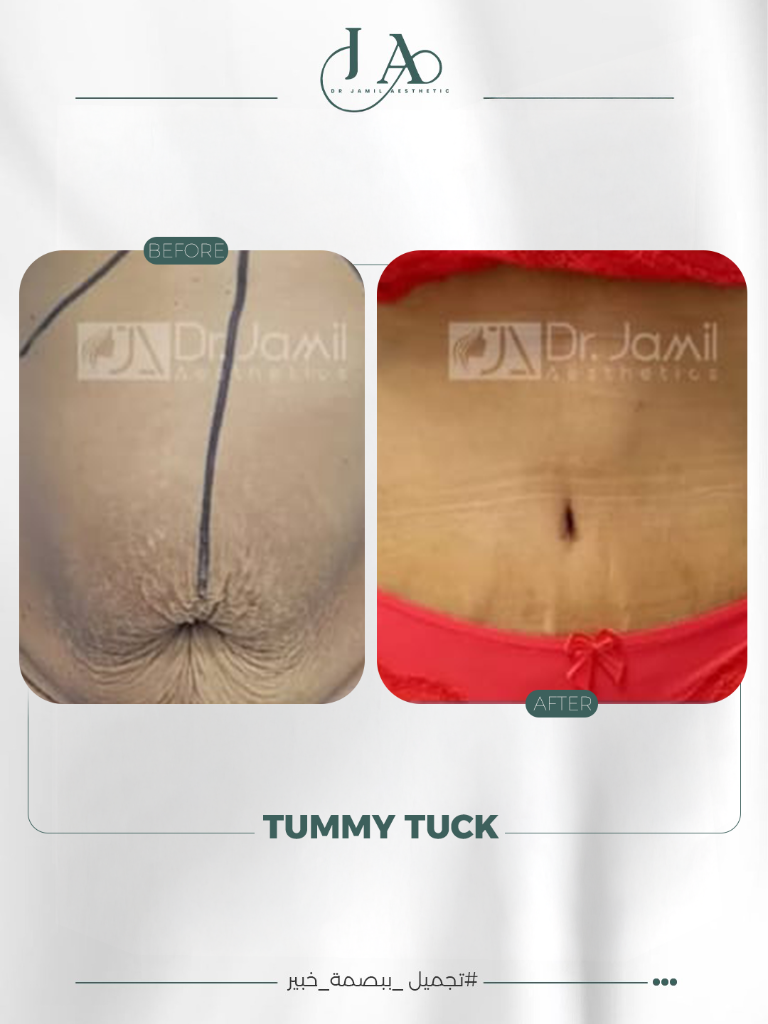 Before / After
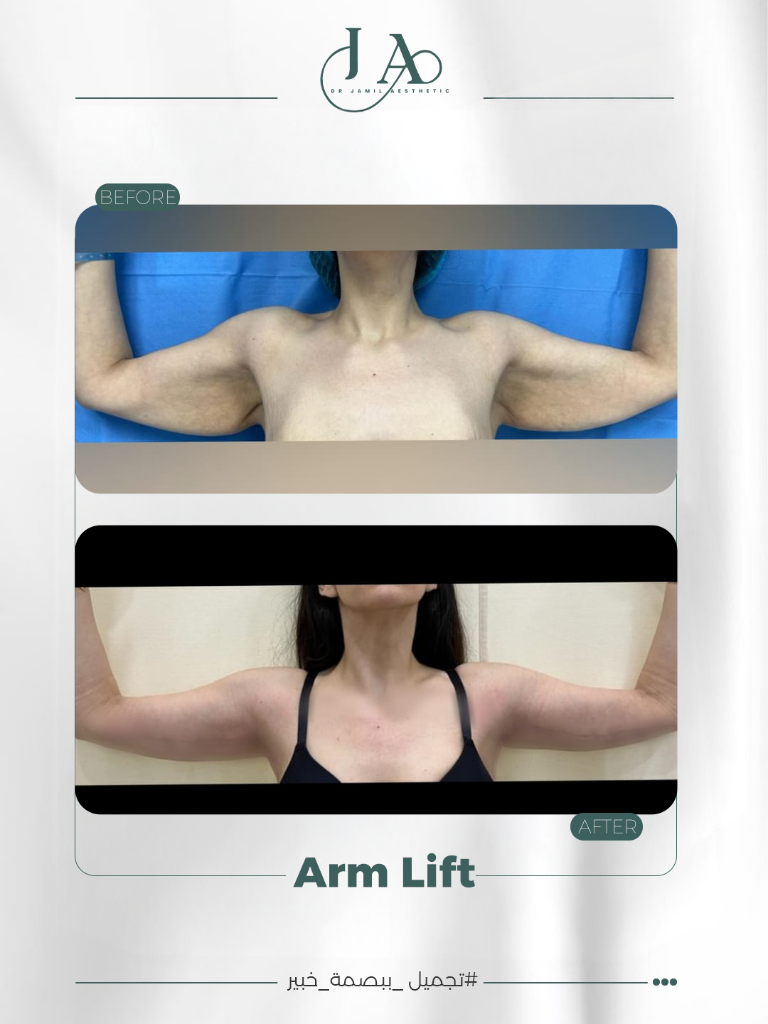 Before / After
Individual results vary. Cases shown with patient consent.
The Navel Detail That Separates Surgeons
Once the muscle is repaired and the excess skin removed, the belly button, which stays attached to its stalk deep in the abdomen, has to be delivered through the newly tightened skin and shaped to look natural: vertical or slightly oval, at the right height, without a harsh circular scar around it. This one step is among the clearest tells of surgical skill, and it is where results diverge most between surgeons. Healed examples sit in the Premium Portfolio. A navel that looks stitched on undermines an otherwise excellent abdomen.
Full or Mini, and Why You Shouldn’t Guess
Not everyone needs a full tummy tuck. A patient with laxity only below the navel and no real muscle separation there may suit a mini abdominoplasty, with a shorter scar and no navel repositioning. A patient with separation reaching above the navel and loose skin across the whole abdomen needs the full procedure to actually fix the problem. Choosing the smaller operation to shrink the scar, when the anatomy calls for the larger one, delivers a partial result that satisfies no one. The assessment should drive this, not a preference for a shorter scar.
Where Liposuction Belongs
A tummy tuck removes skin and repairs muscle. On its own it does not sculpt fatty flanks or a thick upper abdomen. When those are present, targeted liposuction is often combined with the tuck to refine the contour, but it has to be judged carefully, because aggressive liposuction of the abdominal skin flap can compromise its blood supply and healing. Knowing exactly how much the flap can safely take is a technical call, not a bigger-is-better one.
The Functional Side the Brochures Skip
A tummy tuck is filed under cosmetic surgery, but the muscle repair at its heart is functional. A significant separation weakens the whole core, and patients often report lower back pain, poor posture, and a persistent weakness that no training resolved, because the training was strengthening muscles that were not connected in the middle. Repairing the separation restores the abdominal wall as a working unit, and many patients are surprised that back pain they had accepted as permanent eases once the repair heals.
The Scar, and the Recovery
A full tummy tuck leaves a horizontal lower-abdominal scar, and there is no version of the procedure without one. Placement within the natural bikini line and a carefully tensioned closure keep it as low and discreet as possible, and it fades over the following year, but it is permanent and worth understanding before you commit. Recovery starts with walking slightly bent to protect the repair, with most patients upright and managing daily life within two to three weeks and back to full core work only after several months. Rushing the muscle-healing phase is one of the more common ways a good repair gets strained.
Tummy Tuck vs Liposuction
These two get confused constantly, and picking the wrong one guarantees disappointment. Liposuction removes fat and does nothing for loose skin or separated muscle. A tummy tuck removes excess skin and repairs the wall but is not primarily a fat-removal tool. Good skin with stubborn fat points to liposuction; loose skin with muscle separation after pregnancy points to a tummy tuck. Many patients need elements of both, which is why the two are so often combined in one planned operation.
What the Evidence Says
The American Society of Plastic Surgeons describes rectus diastasis repair as an integral part of a tummy tuck, performed by suturing the separated muscles back to the midline, something exercise cannot achieve because the muscles have physically separated rather than weakened. (Source: American Society of Plastic Surgeons (ASPS).)
FAQ
Can diastasis recti be fixed without surgery?
Physical therapy can improve mild separation and the surrounding strength, but a true, significant separation generally needs surgical repair to fully close. Exercise strengthens muscle; it does not rejoin a gap.
What is a drainless tummy tuck?
A tummy tuck that uses internal progressive-tension sutures to close the space between skin and muscle, removing the need for external drains. Patients typically report less early discomfort and nothing to manage at home.
Will I have a visible scar?
Yes. A full tummy tuck leaves a low horizontal scar within the bikini line, designed to hide under underwear and swimwear. It fades over about a year but is permanent.
What is the difference between a full and a mini tummy tuck?
A mini addresses laxity only below the navel with a shorter scar and no navel repositioning. A full tummy tuck addresses the whole abdomen, including separation above the navel, and repositions the belly button. Anatomy decides which fits.
How long is recovery?
Most patients manage daily life within two to three weeks, with full core exercise cleared only once the muscle repair has healed, usually several months out.
If your abdomen has not responded to training the way it should, the reason may be structural rather than a matter of effort. A Strategic Anatomical Assessment can confirm whether diastasis recti is behind it, and what a drainless repair would involve for you. Book an assessment.