
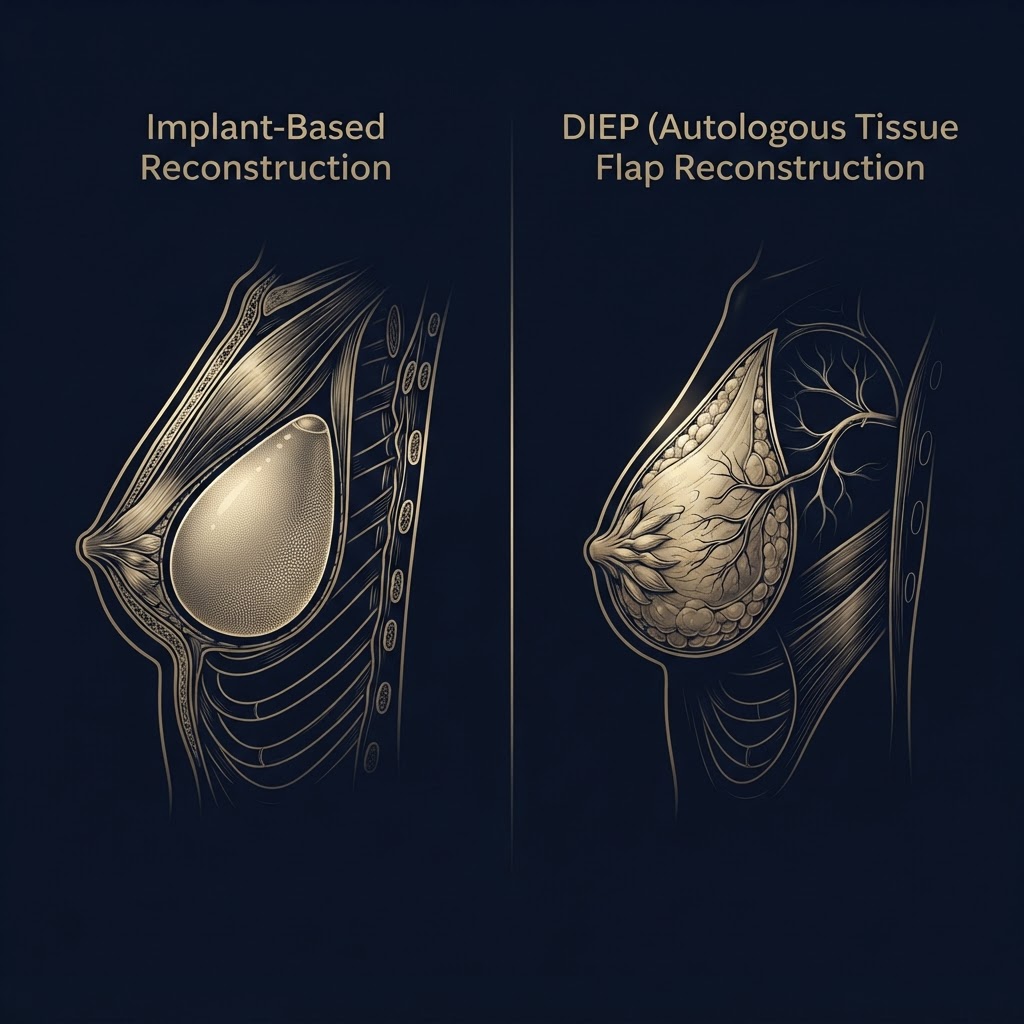
Reconstruction after mastectomy follows one of two broad paths. Neither is universally better. The right one depends on your body, your cancer treatment, and what you are willing to trade.
Medically reviewed by Dr. Jamil Al Jamali, German Board (Facharzt) certified Consultant Plastic, Reconstructive & Hand Surgeon, Dubai. Last reviewed: February 2026. About Dr. Jamil.
Key Takeaways
- Implant reconstruction is a shorter operation with faster recovery; flap reconstruction uses your own tissue and takes longer.
- Radiation strongly influences which method is safe and when it should be performed.
- Neither route is universally better, and the choice is made with the oncology team.
Once reconstruction is on the table, the decision narrows quickly to two families of technique. One rebuilds the breast with an implant. The other rebuilds it with tissue taken from your own body, most commonly the lower abdomen.
Presenting either as the modern or superior choice is misleading. They solve the same problem with different trade-offs, and the correct answer is the one that fits your anatomy and your cancer treatment.
What implant reconstruction involves
This route is usually staged. A tissue expander is placed first and gradually filled to create space and stretch the skin, then exchanged for a permanent implant at a second operation.
The appeal is a shorter operation, no second surgical site, and a faster return to normal activity. The trade-off is that the reconstruction depends on a device, and devices require maintenance over a lifetime.
What flap reconstruction involves
A DIEP flap transfers skin and fat from the lower abdomen to the chest, along with its blood vessels, which are reconnected under the microscope. Muscle is preserved, which distinguishes it from older abdominal flap techniques.
The result is a breast made of living tissue that ages with you and tolerates radiation better. The cost is a longer, more complex operation, a second healing site on the abdomen and a longer recovery.
What the evidence says
A long-term analysis of two-stage implant-based reconstruction in 2,284 women, reported by the American Society of Plastic Surgeons, examined how results hold up over time, while noting that tissue-based reconstruction using the patient's own abdominal tissue involves a longer recovery and is not an option for every patient. (Source: a long-term analysis reported by the American Society of Plastic Surgeons.)
How radiation changes the calculation
Radiated tissue behaves differently. It is less elastic, heals less predictably, and is less forgiving of an expander or implant placed beneath it.
When radiation is planned or has already been given, tissue-based reconstruction often becomes the more reliable route, and timing shifts accordingly. This is one of several reasons the plan is set with the oncology team rather than in isolation, a point developed in the overview of reconstruction as restoration.
Who is not a candidate for a flap
Flap reconstruction requires enough donor tissue and healthy blood vessels. Very slim patients may not have sufficient abdominal tissue, and previous abdominal surgery can compromise the vessels.
Smoking, uncontrolled diabetes and certain vascular conditions raise the risk of flap complications significantly. For these patients implant reconstruction is not a consolation prize, it is the appropriate choice.
Symmetry and the other breast
Reconstruction rarely ends with one operation on one side. Achieving symmetry may involve adjusting the opposite breast, and refinements to shape and scars follow later.
Planning for this from the beginning avoids the impression that something has gone wrong when a second stage is proposed. It was always part of the process, and scar work often forms part of the final refinement.
Deciding without being rushed
Both routes are legitimate, and the decision belongs to you once the medical constraints are clear. A surgeon who advocates only one technique regardless of the patient is describing their practice rather than your options.
The role of the reconstructive assessment is to lay out both honestly, including what each will ask of you.
What recovery actually differs by
Implant reconstruction involves one surgical site and a shorter operation, and most patients return to light activity comparatively quickly, with the expander phase spread over several appointments.
Flap reconstruction involves a longer operation and a second healing site on the abdomen, so early recovery is more demanding and lifting restrictions are stricter. The trade is that once healed, the reconstruction is living tissue requiring no device maintenance.
Questions to bring to the decision
Ask whether radiation is planned, because that single fact reshapes the recommendation more than any preference. Ask how many stages each route will take in your case and over what timeframe.
Ask what happens to each option in ten and twenty years. A surgeon who presents only one technique regardless of these answers is describing their practice rather than your options.
Frequently Asked Questions
Is DIEP flap reconstruction better than implants?
Neither is universally better. Flap reconstruction uses your own tissue and tolerates radiation well but involves a longer operation and recovery. Implant reconstruction is shorter with faster recovery but depends on a device over time.
How does radiation affect reconstruction choice?
Radiated tissue is less elastic and less forgiving of an expander or implant beneath it. When radiation is planned or already given, tissue-based reconstruction is often the more reliable route and timing changes accordingly.
Who is not suitable for a DIEP flap?
Patients without sufficient abdominal donor tissue, those with previous abdominal surgery affecting the blood vessels, and those with risk factors such as smoking or uncontrolled diabetes that raise flap complication rates.
Does reconstruction take more than one operation?
Usually yes. Implant reconstruction is often staged with an expander, and both routes commonly involve later refinements to shape, symmetry and scars. This is planned from the outset rather than being a sign of a problem.
Will surgery be needed on the other breast?
Sometimes. Achieving symmetry can involve adjusting the opposite breast, and this is discussed as part of the overall plan rather than added later as a surprise.
If you are facing reconstruction and want both routes explained honestly, including what each will ask of you, the Strategic Anatomical Assessment with Dr. Jamil is planned alongside your oncology team. Arrange a private consultation.