

Temporary fillers fade on their own. Permanent ones don’t, and years later many migrate, harden, or flare up long after the original appointment is forgotten.
Medically reviewed by Dr. Jamil Al Jamali, German Board (Facharzt) certified Consultant Plastic, Reconstructive & Hand Surgeon, Dubai. Last reviewed: January 2026. About Dr. Jamil.
Key Takeaways
- Permanent fillers cannot be dissolved; removal requires surgical excision.
- They can migrate or harden years, even decades, after injection.
- Restoring natural contour is part of the surgery, not just extraction.
Temporary fillers dissolve on their own within a year or two. Permanent fillers, including silicone and other synthetic compounds injected years ago and still sold in some markets, do not go anywhere. Over time they can drift from where they were placed, harden into firm nodules, or set off a delayed reaction, sometimes long after the original treatment has been forgotten. By the time patients come in, the material has often sat there for a decade, quietly reshaping a face by a decision made by someone else, a long time ago.
How “Permanent” Turned Into a Liability
When these fillers were popular, the pitch was simple: one treatment, no repeats. What was not well understood at the time is how living tissue responds to a foreign material sitting inside it indefinitely, through years of movement, weight change, and aging skin. Migration and hardening are not freak complications of an otherwise fine product. They are a known long-term behaviour of the material. The face is not a still canvas. It moves thousands of times a day, and over years those movements can carry a permanent filler well away from where it started.
Why Removal Means Surgery
Hyaluronic acid fillers can be dissolved with an enzyme in a quick appointment. Permanent fillers cannot be dissolved by anything. Taking them out means surgical excision, carefully separating the material from the tissue, nerves, and blood vessels it may have integrated with over years. This is why permanent filler removal sits firmly inside Dr. Jamil's revision and corrective surgery work rather than in any walk-in category. It is delicate, the anatomy is distorted by the material itself, and the margin for error near facial nerves is small.
Real Results
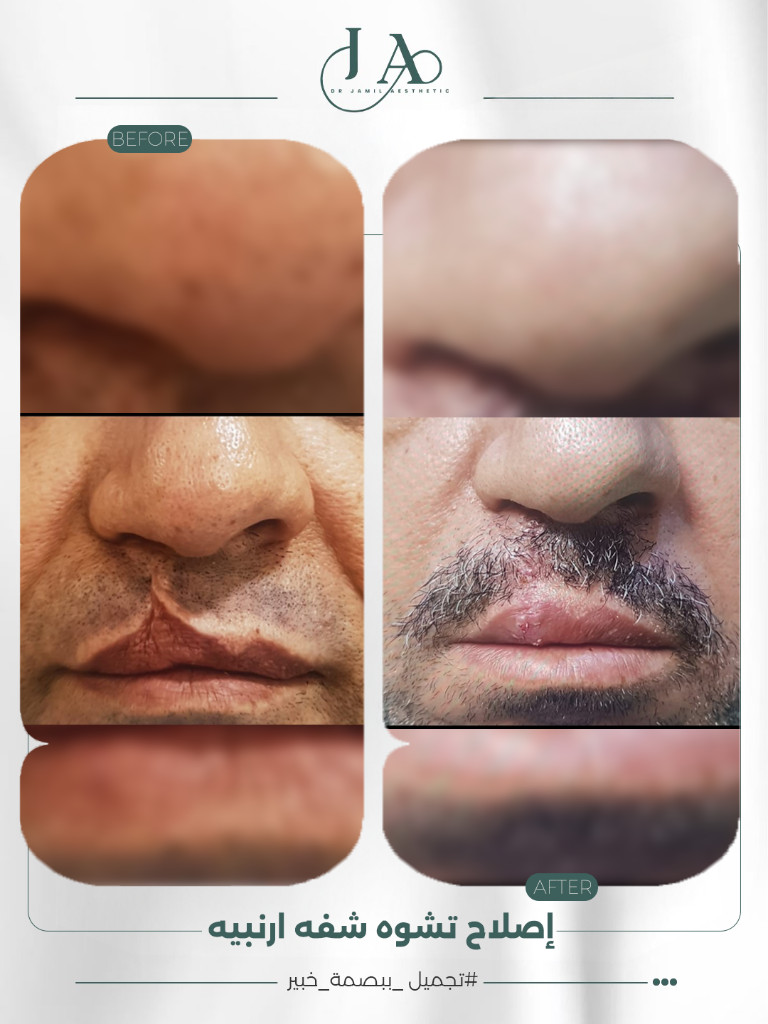 Before / After
Individual results vary. Cases shown with patient consent.
The Micro-Surgical Approach
Because the material has often spread and bonded to healthy tissue, removal is done under magnification, tracing the filler through the tissue planes and extracting it while preserving as much healthy structure as possible. It is meticulous work, closer to reconstruction than to a cosmetic touch-up, and rarely a single simple pass. In some cases not every trace can be removed safely in one procedure without damaging what surrounds it, and a staged approach is the more responsible path. An honest surgeon says so upfront rather than promising a clean sweep that risks harm.
The Damage Underneath
Long-standing filler can leave the tissue beneath it scarred, thinned, or distorted, so extraction is often only the first half of the work. Restoring natural contour afterward, sometimes with the patient's own fat and sometimes with scar revision, is what turns removal into an actual improvement rather than an empty, deflated area where the filler used to be. There is a real difference between a surgeon who will take the material out and one who will give the face back its shape.
Why Patients Get Turned Away Elsewhere
A theme runs through these cases: patients were refused before they arrived. The material has spread unpredictably, distorted the anatomy, and bonded to healthy tissue, and many surgeons understandably prefer not to take on that risk. So patients are left living with a problem they were told was permanent in every sense. Taking these cases on is a deliberate part of this practice's identity, and it rests on the microsurgical and reconstructive skill to work safely in distorted tissue. For patients refused before, being taken seriously is often the first relief the consultation brings.
The Second Chance It Offers
Most people coming in for this are years into living with a face that no longer matches how they see themselves, distorted by material that shifted or hardened long after the fact. The surgery is not vanity. In the great majority of cases it is tissue restoration for a problem the patient did not cause and could not have foreseen at the time. Recovery depends on the extent and location of the material, and because the tissue was already distorted, the restored contour takes time to settle and may involve a planned second stage. What patients tend to describe afterward is not a dramatic transformation, but the quieter relief of a face that looks like theirs again.
What the Evidence Says
A Mayo Clinic review found that complications from silicone were detected a median of 22 years after the original injection, ranging from 1 to 40 years, and that migration often makes complete surgical removal impossible. (Source: Mayo Clinic review (Mayo Clinic Proceedings).)
FAQ
Can permanent filler be dissolved instead of cut out?
No. Unlike hyaluronic acid fillers, permanent fillers such as silicone cannot be broken down with an enzyme. Surgical excision is the only reliable method.
How do I know if I have a complication?
Firm or hard nodules, asymmetry that developed over time, material that has migrated to areas it was not injected, or recurring inflammation are all signs. A structural assessment with imaging confirms how much material is present and where.
Is it fully removed in one surgery?
Not always. When material has spread and bonded to healthy tissue, removing every trace in a single pass can risk damage, so a staged approach is sometimes the safer plan.
Will my face look normal afterward?
The goal is a restored, natural contour, which often means addressing the tissue damage the filler left behind, with fat grafting or scar revision, not just removing the material.
How do I know whether my filler is permanent or temporary?
Temporary hyaluronic acid fillers fade within roughly six to eighteen months and reverse with an enzyme. Permanent fillers never leave and cannot be dissolved. If you do not know what was injected, that uncertainty is itself a reason for a proper assessment, ideally with imaging.
If your face carries the aftermath of a permanent filler decision made years ago, this is the kind of case Dr. Jamil takes on personally. A Strategic Anatomical Assessment, including imaging, will map what is actually there and what restoring it would involve. Request a private consultation. #TheSecondChance