

Rhinoplasty has the highest revision rate in facial surgery, and most of those redo cases share one cause: a nose reshaped for looks without a plan for the framework beneath it.
Medically reviewed by Dr. Jamil Al Jamali, German Board (Facharzt) certified Consultant Plastic, Reconstructive & Hand Surgeon, Dubai. Last reviewed: January 2026. About Dr. Jamil.
Key Takeaways
- Structural rhinoplasty reinforces cartilage instead of removing it, protecting both shape and breathing.
- Thicker Middle Eastern noses need tip-support grafting, not aggressive reduction.
- Revision cases are harder because native cartilage is often already depleted.
Walk into a rhinoplasty consultation and you will probably describe a shape: a smaller bridge, a lifted tip, a straighter profile. Fair enough, that is what you see in the mirror. But the thing that decides whether that shape is still there in fifteen years is not the shape at all. It is airflow, and the cartilage that keeps the airway open.
Rhinoplasty carries the highest revision rate of any facial procedure. Dig into why, and the same root keeps showing up: a nose narrowed for appearance while the framework holding it up got weakened in the process. Understanding that framework is the single most useful thing you can bring into a consultation.
Where the Old Approach Fails
Cartilage does the structural work of the nose. It holds the tip up, keeps the internal airway open, and supports the skin from beneath. Older reduction techniques chased a smaller silhouette by trimming cartilage aggressively, and at first it looked great. Years later the same noses began to collapse inward: a dropped tip, narrowed nostrils, and often worse breathing than before the surgery. That pinched, over-done look tends to appear fine at six months and become obvious at six years, which is how it slips past patients judging a surgeon on recent photos alone.
Reinforce, Do Not Just Remove
Structural rhinoplasty builds support rather than stripping it out. It uses cartilage grafts, usually harvested from the patient's own septum, to strengthen the areas being reshaped so the nose keeps its scaffolding. Where a previous surgery or an injury has already used up the septum, cartilage can come from the ear, or from the rib for larger reconstructions. You end up with a nose that is smaller, straighter, or more refined and still has the internal architecture to breathe and hold its shape for the rest of your life. The same engineering logic runs through all of Dr. Jamil's work on the face.
Real Results
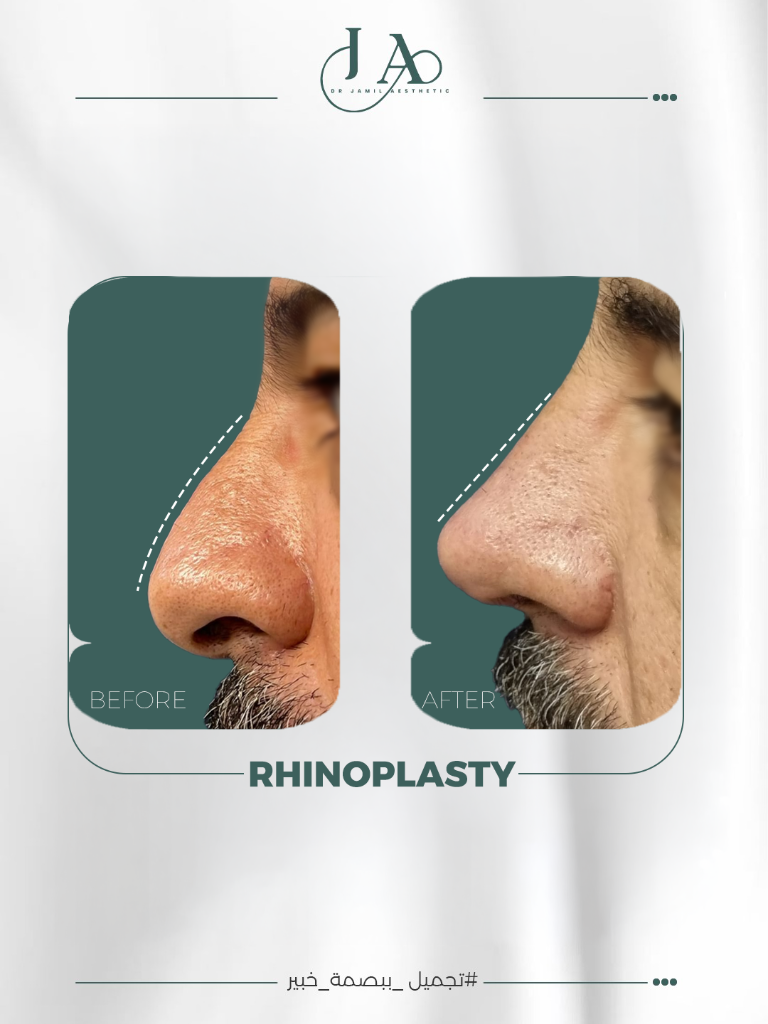 Before / After
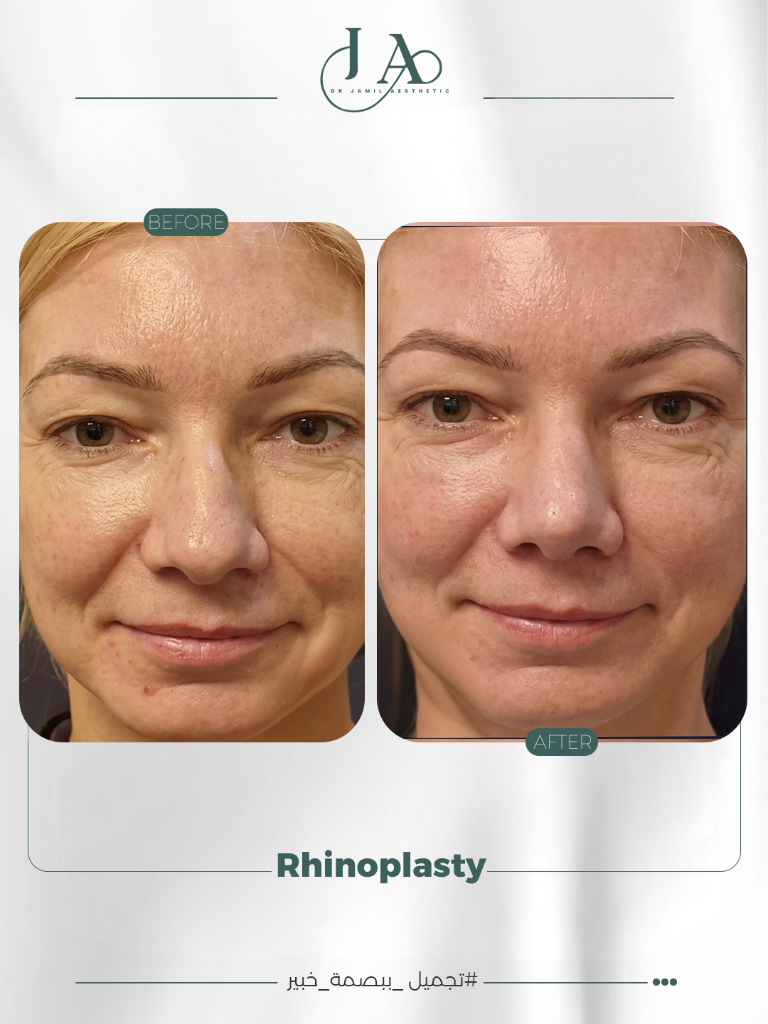 Before / After
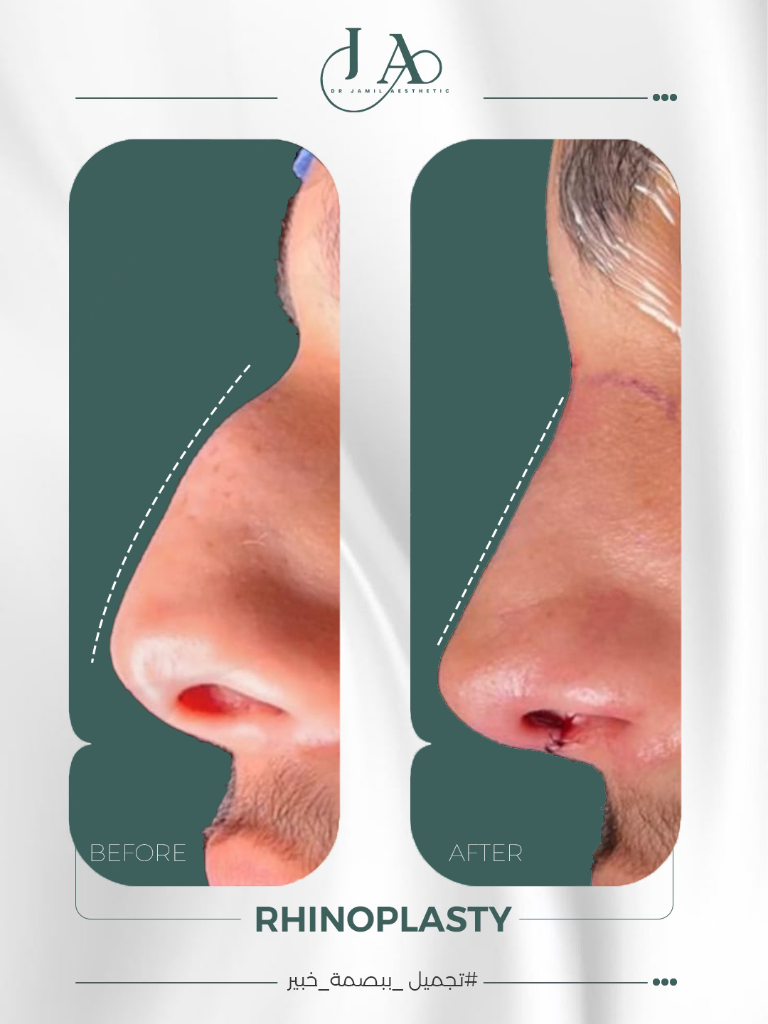 Before / After
Individual results vary. Cases shown with patient consent.
The Middle Eastern Nose Is Its Own Problem
Ethnic nasal anatomy deserves more than a footnote. Many Arabic and Middle Eastern noses combine thicker skin, a stronger dorsal hump, and a tip held up by weaker lower cartilages. Take a technique designed for thin European skin and apply it here, and the failure is predictable: a tip that never quite refines because the thick skin will not shrink to reveal it, or a scooped bridge that looks wrong on the face. The right approach leans on tip-support grafting and conservative dorsal reduction, on the understanding that thicker skin needs a stronger frame beneath it, not a smaller one.
A Nose Is Judged Against the Whole Face
No one looks at a nose in isolation. Its width, projection, and the angle where it meets the lip are read against the forehead, chin, and mouth, using the golden-ratio proportions that guide facial analysis. Reduce a nose without that context and it can look surgically altered even when the technical work is clean, simply because it no longer fits the face around it. Sometimes the honest finding is that the nose was never the main issue. A weak chin can make a perfectly normal nose look large, and addressing the chin rebalances everything.
Primary and Revision Are Two Different Sports
A first-time rhinoplasty works with an untouched framework and a predictable blood supply. A revision works with a nose that has already been operated on, often with cartilage gone, scar tissue in the way, and landmarks shifted. That is why revision rhinoplasty sits inside Dr. Jamil's revision and corrective surgery focus and gets treated as a harder, separate operation. Anyone seeking correction of a previous nose job should expect more imaging, a more cautious plan, and a frank talk about what the remaining cartilage will allow.
Surgery vs the “Liquid Nose Job”
Non-surgical rhinoplasty, using filler to smooth a bump or tweak the tip, gets marketed as the low-risk alternative. It has a narrow legitimate use for camouflaging a small dorsal irregularity, but it is worth being clear about its limits. Filler cannot make a nose smaller, cannot open a blocked airway, and cannot lift a drooping tip. It adds volume to a structure, which is the opposite of what most patients are after. There is a safety angle too, since the nose has a dense, unforgiving blood supply and filler complications here rank among the more serious in aesthetic medicine.
The Long Refinement
The external cast comes off in about a week, and most patients are socially presentable, if a little swollen, within two. What catches people off guard is how long the fine settling takes. Tip skin, especially thicker skin, can need twelve to eighteen months to fully define as swelling resolves and grafts integrate. Judging the result at three months is a mistake. The nose at a year and a half is the real one, which is part of why patience and structured follow-up matter as much here as the surgery itself.
What the Evidence Says
Surgeons need cartilage from outside the nose in about 13% of primary rhinoplasties, but that figure rises to roughly 24% in revision cases where the septum has already been depleted, according to survey data published in the Australian Journal of Otolaryngology. (Source: Australian Journal of Otolaryngology (2025).)
FAQ
Does structural rhinoplasty help or hurt breathing?
Done properly it should protect or improve breathing, because it reinforces cartilage instead of removing it. Many structural cases pair cosmetic reshaping with functional correction of a deviated septum in the same operation.
How long until the result is final?
Swelling settles over a few weeks, but the tip and overall shape keep refining for twelve to eighteen months as grafts integrate and skin redrapes. Thicker skin takes longer to reveal the final definition.
Is it different for Arabic or Middle Eastern noses?
Yes. Thicker skin and a stronger framework call for tip-support grafts and conservative reduction rather than aggressive removal. Borrowing a thin-skin European technique for this anatomy is a common cause of a disappointing tip.
Can a failed nose job be corrected?
Often, yes, though revision is more demanding because it works with depleted cartilage and scar tissue. Structural grafting, sometimes using ear or rib cartilage, is frequently what rebuilds the missing support.
Why is cheap rhinoplasty a false economy?
The nose is the least forgiving facial procedure to get wrong and the most expensive to fix. A revision is harder than the original and can cost more in time, money, and stress than doing it well once. Treating it as structural engineering from the start is what avoids a second surgery.
When can I judge my final result?
Not before twelve months, and closer to eighteen for thicker-skinned noses. Early swelling can hide or exaggerate features, so the shape at three months is not the shape you keep.
Your nose carries the proportion of your whole face and half your breathing. Both deserve more than a quick answer across a desk. Book a Strategic Anatomical Assessment to see how your nasal structure, not just its outline, shapes the plan. Request a consultation.