
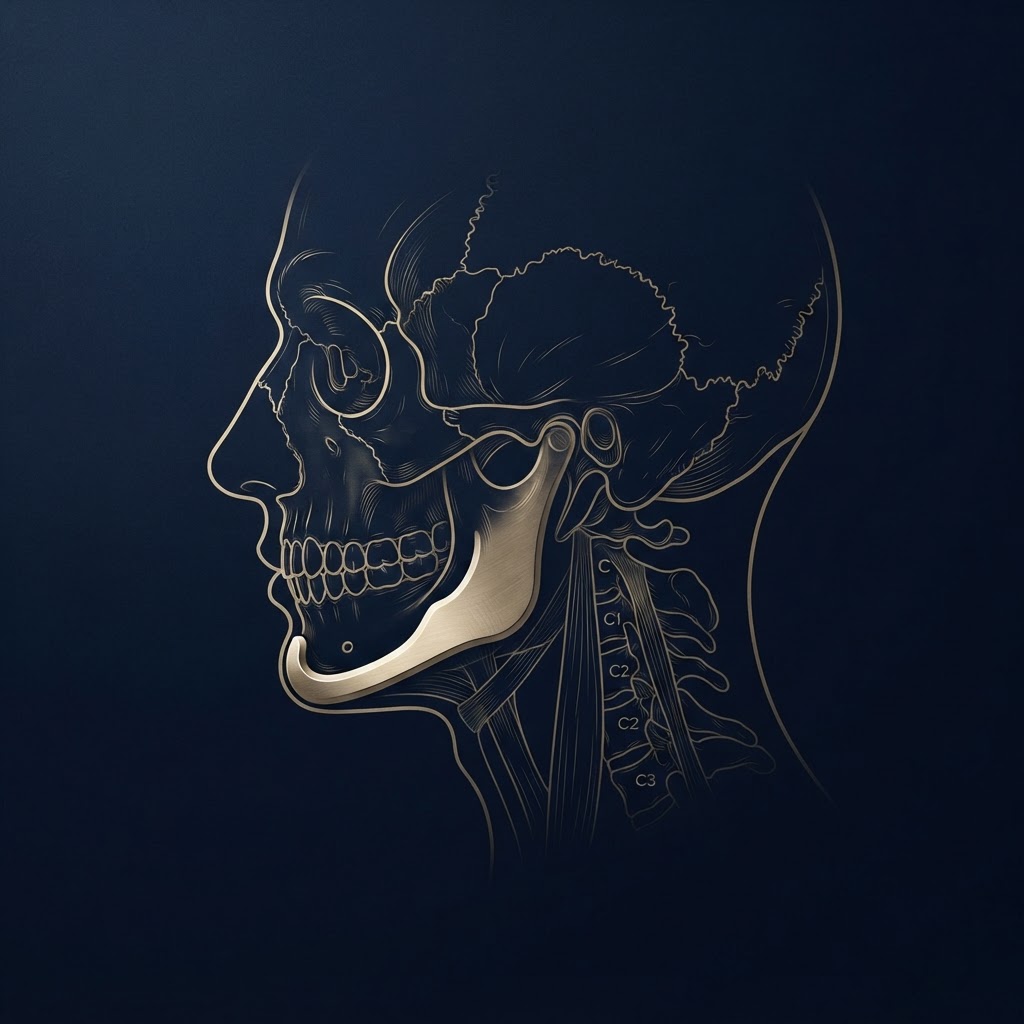
Filler sits on top of bone and lasts months. A facial implant rebuilds the underlying structure permanently, and when designed to your own anatomy it behaves like part of the skeleton rather than an addition.
Medically reviewed by Dr. Jamil Al Jamali, German Board (Facharzt) certified Consultant Plastic, Reconstructive & Hand Surgeon, Dubai. Last reviewed: February 2026. About Dr. Jamil.
Key Takeaways
- Filler adds temporary volume above bone; an implant rebuilds the skeletal structure permanently.
- Patient-specific implants designed to your own scan fit more precisely than off-the-shelf sizes.
- A weak chin often explains a profile complaint that patients mistakenly attribute to the nose.
When someone wants a sharper jaw or a stronger chin, filler is usually offered first because it is quick. For a modest, temporary change that can be reasonable. But filler adds volume on top of bone; it does not rebuild bone.
Where the shortfall is skeletal, stacking filler over it produces a puffy, indistinct fullness rather than definition. The problem is structural, and the durable answer is structural too.
What the implant actually does
A facial implant is a solid form placed directly on the bone, restoring projection where the skeleton is deficient. Because it sits on bone rather than in soft tissue, the change reads as part of the face rather than an overlay.
It is permanent, which is both the advantage and the reason planning matters. Reversing an overlarge implant is a further operation, so restraint at the design stage is not optional.
What patient-specific design changes
Off-the-shelf implants come in approximate sizes and are trimmed during surgery to fit the bone, which introduces variability. A patient-specific implant is designed from a scan of your own skeleton and manufactured to match it.
Precise fit reduces the chance of movement, shortens operating time because the implant seats correctly first time, and produces contours that follow your existing bone rather than approximating it.
What the evidence says
A systematic review covering 54 years of facial implant experience reported an overall complication rate of 4.4 percent, and found that patient-specific implants designed to the individual's anatomy showed promising results in reducing complications such as infection. (Source: a systematic review covering 54 years of facial implant experience (PMC).)
Chin and jaw angle are different problems
A chin implant addresses a recessed or short chin and mainly improves the profile. A jaw angle implant widens and sharpens the posterior jaw, which is more often requested by men seeking definition.
Some faces need one, some need both, and some need neither. Overbuilding either produces the heavy, artificial look that reveals the intervention, which is exactly what executive facial surgery is designed to avoid.
The profile problem people misattribute
Patients frequently ask about the nose when the profile complaint is actually chin projection. A short chin makes a normal nose look larger, and reducing the nose to compensate weakens the face further.
Assessing the profile as a whole prevents that error. The relationship between nasal support and facial balance is set out in the article on what holds the nose up, and chin position is the other half of that equation.
Where it fits alongside lifting surgery
Restoring skeletal support and repositioning descended soft tissue solve different aspects of the same appearance. A defined jaw angle can complement the result of deep plane surgery rather than competing with it.
Whether you need one, the other or both is an assessment question. Combining them without a clear reason is how a face ends up overdone.
Incisions, safety and recovery
Implants are placed through hidden incisions, commonly inside the mouth or within a natural crease, so no visible scar results. Precise seating on bone reduces the risk of displacement.
Most patients return to private life within one to two weeks as swelling subsides. The final contour emerges over the following weeks and, because the implant is fixed to bone, remains stable thereafter.
Alternatives worth considering first
Not every weak profile needs an implant. Where the deficiency is modest, fat grafting can add soft tissue volume using your own tissue, and in cases involving the bite or significant skeletal discrepancy, jaw repositioning surgery may be the more complete answer.
Assessment separates these situations. Choosing an implant for a problem that is fundamentally about jaw position produces a result that looks improved on the surface and remains unbalanced underneath.
What restraint looks like in practice
The most common error is building too much. An oversized chin or an overly wide jaw angle reads as artificial immediately, and correcting it means further surgery on tissue that has already been dissected.
A slightly conservative implant integrates into the face and looks like anatomy. That principle applies equally to corrective work, where undoing an overbuilt result is consistently harder than the original operation.
Frequently Asked Questions
What is the difference between a chin implant and filler?
Filler adds temporary volume above the bone and needs repeating. An implant restores the skeletal structure itself and is permanent, so the change reads as part of the face rather than an overlay.
Are facial implants safe?
Systematic review of 54 years of facial implant experience reported an overall complication rate of 4.4 percent, with patient-specific implants showing promise in reducing complications such as infection through precise fit.
Will a chin implant leave a visible scar?
Implants are placed through hidden incisions, commonly inside the mouth or in a natural crease, so no visible external scar results in most cases.
Do I need a chin implant or rhinoplasty?
Sometimes the profile complaint attributed to the nose is actually a short chin, which makes a normal nose look larger. Assessing the profile as a whole prevents reducing the nose unnecessarily.
Is a custom implant better than a standard one?
A patient-specific implant is designed from a scan of your own skeleton, so it fits precisely rather than being trimmed to approximate the bone. That reduces movement risk and produces contours following your own anatomy.
If your concern is a soft jawline or a weak profile, the useful first question is whether the shortfall is skeletal or soft tissue. The Strategic Anatomical Assessment with Dr. Jamil answers that with imaging before any technique is chosen. Arrange a private consultation.