
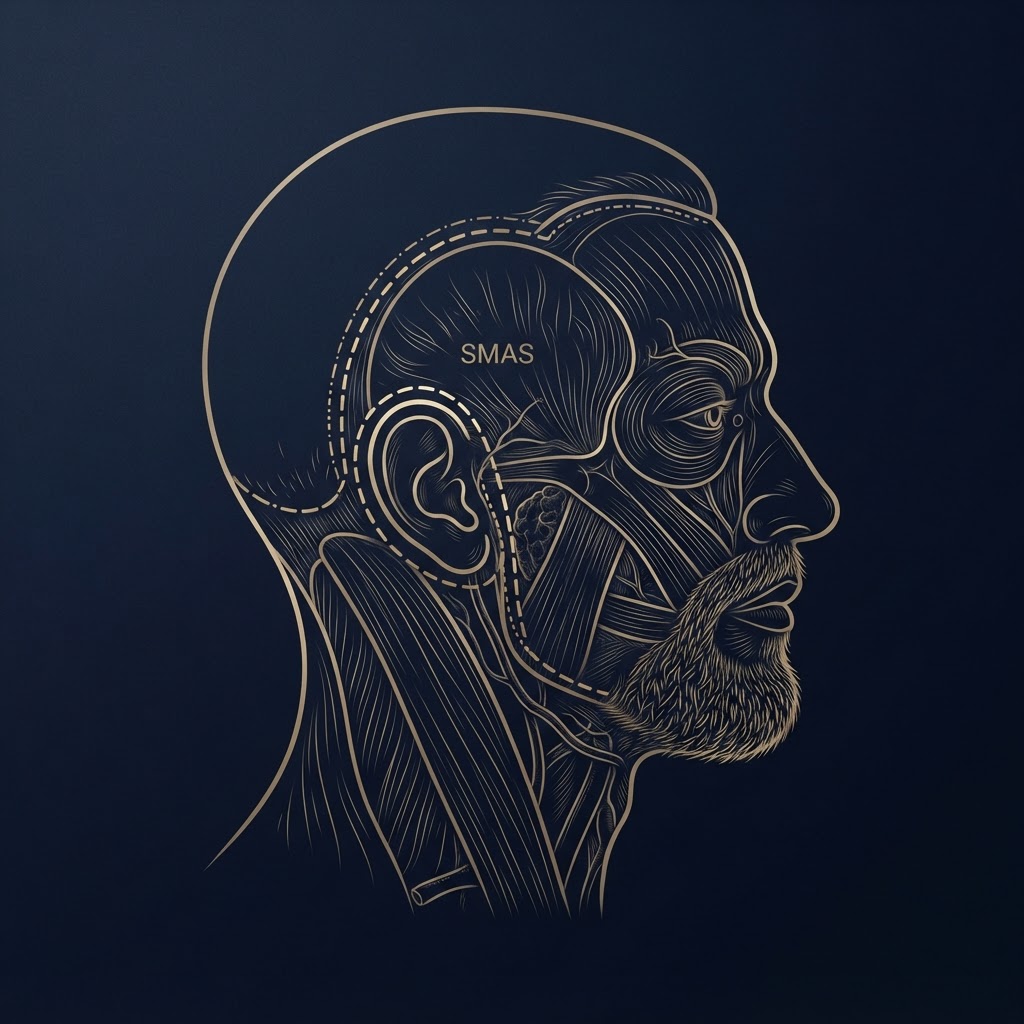
Men rarely want a different face. They want the fatigue removed from the one they have, without anything about it announcing that surgery took place. That constraint shapes every technical decision.
Medically reviewed by Dr. Jamil Al Jamali, German Board (Facharzt) certified Consultant Plastic, Reconstructive & Hand Surgeon, Dubai. Last reviewed: February 2026. About Dr. Jamil.
Key Takeaways
- Male facial anatomy differs in skin thickness, blood supply and beard-bearing skin, which changes incision planning.
- The deep plane approach avoids the swept-back appearance men most want to avoid.
- The neck is usually part of the plan, because the jawline carries most of the professional impression.
The men who come to discuss facial surgery almost never describe wanting to look different. They describe looking tired in photographs, or being told they seem worn out during a week that was not especially hard.
That is a narrow brief and a demanding one. The result has to remove the fatigue while leaving no signal that anything was done, because in professional settings the appearance of intervention carries its own cost.
Why male anatomy changes the plan
Male facial skin is thicker and carries a richer blood supply, which affects both bleeding during surgery and how the tissue behaves afterwards. Beard-bearing skin adds a constraint no female facelift has to consider.
Move hair-bearing skin into the wrong position and a man is shaving in front of his ear or behind it for the rest of his life. Incision design has to account for where the beard sits before a single cut is planned.
The look men are trying to avoid
The fear is specific and well founded: the swept-back, tightened appearance that reads instantly as surgical. That look comes from tension carried by the skin.
Working in the deep plane places the tension beneath the skin, at the layer that actually descended, and lifts upward toward the cheekbone rather than backward toward the ear. The mechanism is explained fully in the piece on depth and the pulled look, and it applies with even more force to a male face.
What the evidence says
StatPearls notes that a standard cervicofacial rhytidectomy adequately addresses most age-related changes of the neck and remains the gold standard, with isolated neck lifting reserved for patients unwilling to undergo a full facelift, which is why the two are usually planned together. (Source: StatPearls (NCBI Bookshelf).)
The jawline does most of the work
For men, the jaw and neck carry a disproportionate share of the professional impression. Correcting the face while leaving a soft neck produces a result that satisfies nobody.
Consequently neck lift is usually planned alongside, so the transition from jaw to neck reads as one clean line. That reasoning is developed in the comparison of what the neck and face each contribute.
Preserving the features that read as male
A strong jaw angle, a relatively flat cheek and a lower, straighter brow are structurally masculine. Techniques that soften or over-elevate these features produce a face that looks refreshed and subtly wrong.
Restraint here is technical, not aesthetic preference. The goal is a man who looks like himself after a genuinely good month, which is the standard executive facial surgery is built around.
Discretion as part of the plan
Many men need the entire process to remain private, and that requirement is treated as a clinical constraint rather than a courtesy. It shapes scheduling, incision placement and the pacing of review appointments.
The patient journey is structured so the surgical timeline fits around professional obligations rather than colliding with them.
Recovery in a working life
Most men are comfortable in private settings within two to three weeks, once the bulk of swelling and bruising has cleared. Numbness around the ears is expected early and resolves as the nerves recover.
Deeper settling continues over months, and the structured German aftercare protocol treats that window as part of the operation rather than as time off.
Bleeding risk and why preparation matters more
The richer blood supply in male facial skin raises the risk of collecting blood beneath the flap after surgery, particularly where blood pressure is not well controlled.
Consequently blood pressure management before and after the operation, stopping specific supplements and medications, and strict early activity limits carry more weight in men than they do in many female patients. These are risk controls rather than general advice.
What surgery does not address
A facelift repositions descended tissue. It does not improve skin texture, pigmentation, fine lines or hair loss, and men whose main complaint falls into those categories are describing a different problem.
Being clear about that distinction before surgery prevents the disappointment of a technically excellent result that did not address the actual complaint. That separation of structure from surface runs through the discussion of which layer a facelift treats.
Frequently Asked Questions
How is a facelift for men different?
Male skin is thicker with richer blood supply, and beard-bearing skin must be accounted for in incision design to avoid shaving around the ear afterwards. Masculine features such as jaw angle and brow position also need preserving rather than softening.
Will a facelift make me look done?
The swept-back appearance comes from tension carried by the skin. Working in the deep plane places tension beneath the skin and lifts toward the cheekbone rather than backward, which preserves expression and avoids that look.
Do I need the neck done as well?
Usually yes. For men the jawline and neck carry much of the professional impression, so correcting the face while leaving a soft neck produces an uneven result. The two are commonly planned together.
How long before I can return to work?
Most men are comfortable in private settings within two to three weeks as swelling and bruising clear. Deeper settling continues over months, and the schedule can be planned around professional commitments.
Can the process be kept private?
Yes. Discretion is treated as a clinical constraint that shapes scheduling, incision placement and review appointments, rather than as an optional service.
If you want the fatigue removed without anything announcing that surgery happened, the Strategic Anatomical Assessment with Dr. Jamil is conducted with complete discretion and an honest reading of what your face needs. Arrange a private consultation.