
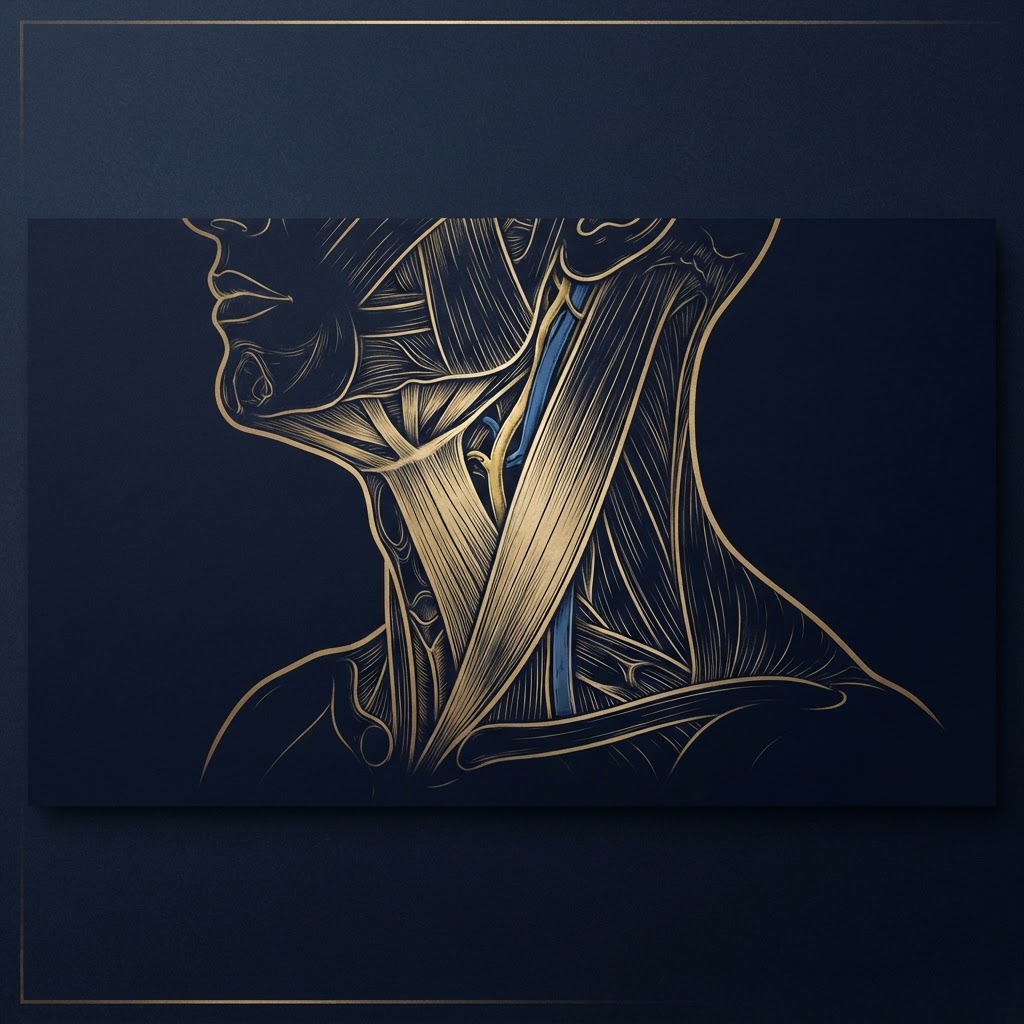
A blurred jawline and vertical neck bands are muscle problems, not skin problems. Understanding which layer has dropped decides whether you need a neck lift, a facelift, or both.
Medically reviewed by Dr. Jamil Al Jamali, German Board (Facharzt) certified Consultant Plastic, Reconstructive & Hand Surgeon, Dubai. Last reviewed: February 2026. About Dr. Jamil.
Key Takeaways
- Vertical neck bands come from the platysma muscle, so tightening skin alone does not remove them.
- A neck lift treats the muscle and excess skin below the jaw; a facelift treats the cheek and jowl above it.
- Because face and neck age together, the two are frequently planned as one operation.
Patients rarely arrive asking for a platysmaplasty. They arrive saying their jawline has gone soft, or that a cord appears in the neck when they speak. Those are two different complaints, and they point to the same layer.
The confusion is understandable. Loose neck skin looks like a skin problem, so tightening skin sounds like the fix. It is not, and that misunderstanding explains a large share of disappointing neck results.
The muscle behind the bands
A thin sheet of muscle called the platysma runs from the collarbones up into the lower face. With age its edges separate and slacken, and those free edges show through the skin as the vertical cords people notice when they talk or tense the neck.
Skin tightening does nothing to a slack muscle edge. You can pull the covering taut and the cord underneath still sits there, which is why bands so often return within months of a skin-only procedure.
What the evidence says
In a prospective single-blind study of 80 patients followed for five years, complete platysma muscle transection during face and neck lifting produced significant improvement with no recurrence of platysmal bands and a low complication rate, which supports treating the muscle layer rather than the skin alone. (Source: a prospective study in Aesthetic Plastic Surgery (PMC).)
What a neck lift actually does
A neck lift addresses the layer that failed. The platysma is tightened and sutured together in the midline, correcting the vertical bands, excess skin is removed, and fat under the chin is treated when it is contributing.
This is a removal and reconstruction procedure rather than an addition, which is the core difference from injectable jawline contouring.
Where the facelift takes over
The dividing line is roughly the jaw. Below it, the neck lift handles bands, loose skin and submental fat. Above it, the cheek descent and jowl belong to the facelift, and specifically to the layer discussed in the piece on why a pulled look means the wrong depth.
Treating one and ignoring the other tends to look uneven. A corrected neck under an untreated jowl, or a lifted cheek above a banded neck, reads as two different ages on one face.
When one procedure is genuinely enough
Some patients do well with an isolated neck lift. Typically they are younger, the cheek and midface still sit where they should, and the complaint is confined to bands or submental fullness.
Others have the opposite pattern. The honest answer comes from examination rather than from a menu, and part of Dr. Jamil's approach is being willing to say that the smaller operation will serve you better.
Scars and where they hide
Neck lift incisions usually sit behind the ear and, when the midline muscle needs direct access, in a short crease under the chin. Both locations fall into natural shadows and settle well.
As with deep plane surgery, closure without tension is what keeps these lines fine. A scar dragged tight while it heals is the scar that widens.
Recovery, told straight
Most people are comfortable in private life within about two weeks, which is when the bulk of swelling and bruising clears. A sensation of tightness when swallowing is normal early on and eases as the tissues relax.
Deeper settling continues quietly for several months. Numbness along the jaw and behind the ears is expected in the first weeks and resolves as the nerves recover.
Men and the executive jawline
For many men the jawline carries a professional weight, and a softening neck reads as fatigue rather than age. The anatomy is the same, but beard-bearing skin and incision placement need specific planning.
That work sits within the men's facelift pathway, where discretion and incision design are treated as part of the surgical plan rather than as a service extra.
What a neck lift will not fix
Two complaints are regularly brought to a neck lift consultation that the operation does not address. The first is submental fullness caused by a low-lying salivary gland or by deep fat beneath the muscle, which needs a different intervention and carries different risks.
The second is a receding chin. A short chin shortens the apparent neck and blurs the jawline regardless of how well the platysma is treated, and in those cases skeletal support is the missing piece rather than muscle tightening.
Questions worth asking before you book
Ask which layer the surgeon intends to treat and why that layer specifically. Ask whether the platysma will be addressed directly in the midline or only from the sides, since that distinction predicts whether bands return.
Ask to see results at one year rather than at six weeks, when tension and scar quality have declared themselves. Vague answers, or one technique offered to every patient, are worth noticing.
Frequently Asked Questions
Can a neck lift fix neck bands permanently?
Bands come from the platysma muscle, so a neck lift that tightens and joins the muscle in the midline addresses the actual cause. Published five-year follow-up of complete platysma treatment reported no recurrence of bands, which is far more durable than skin-only tightening.
Do I need a facelift as well as a neck lift?
It depends where the change is. If the cheek and jowl still sit well and the complaint is confined below the jaw, a neck lift alone can be enough. When both areas have descended, treating only one tends to look uneven.
Will a neck lift leave a visible scar?
Incisions are usually placed behind the ear and, when midline muscle access is needed, in a short crease under the chin. Both sit in natural shadows and typically settle to a fine line.
How long is recovery after a neck lift?
Most patients are comfortable in private life within about two weeks as swelling and bruising clear. Tightness on swallowing is normal early, and deeper settling continues over several months.
Is jawline filler an alternative to a neck lift?
Filler adds volume and can sharpen a jawline that has lost definition but still has good skin tone. It cannot remove excess skin or tighten a slack muscle, so it is not a substitute when bands or loose skin are the issue.
If your jawline has softened and you want to know which layer is actually responsible, the Strategic Anatomical Assessment with Dr. Jamil starts with an honest reading of your own anatomy rather than a standard package. Arrange a private consultation.