
No scar disappears. But a raised, tethered or badly placed scar can often be made quieter, flatter and far less noticeable, provided the plan matches the type of scar you actually have.
Medically reviewed by Dr. Jamil Al Jamali, German Board (Facharzt) certified Consultant Plastic, Reconstructive & Hand Surgeon, Dubai. Last reviewed: February 2026. About Dr. Jamil.
Key Takeaways
- No scar can be erased; the realistic goal is flatter, paler and less noticeable.
- Combined treatment generally outperforms any single method, and injection is the strongest single modality.
- Cutting out a raised scar without preventing recurrence often produces another raised scar.
Scars are often treated as a surface problem, which is why creams are the usual first suggestion. For a fine, flat scar that may be reasonable. For a raised, tethered or spreading scar it is not, because the problem sits in the depth of the tissue.
A complex scar is fibrous tissue that has grown differently from the skin around it. Improving it means changing that tissue, not polishing what sits on top.
What makes a scar complex
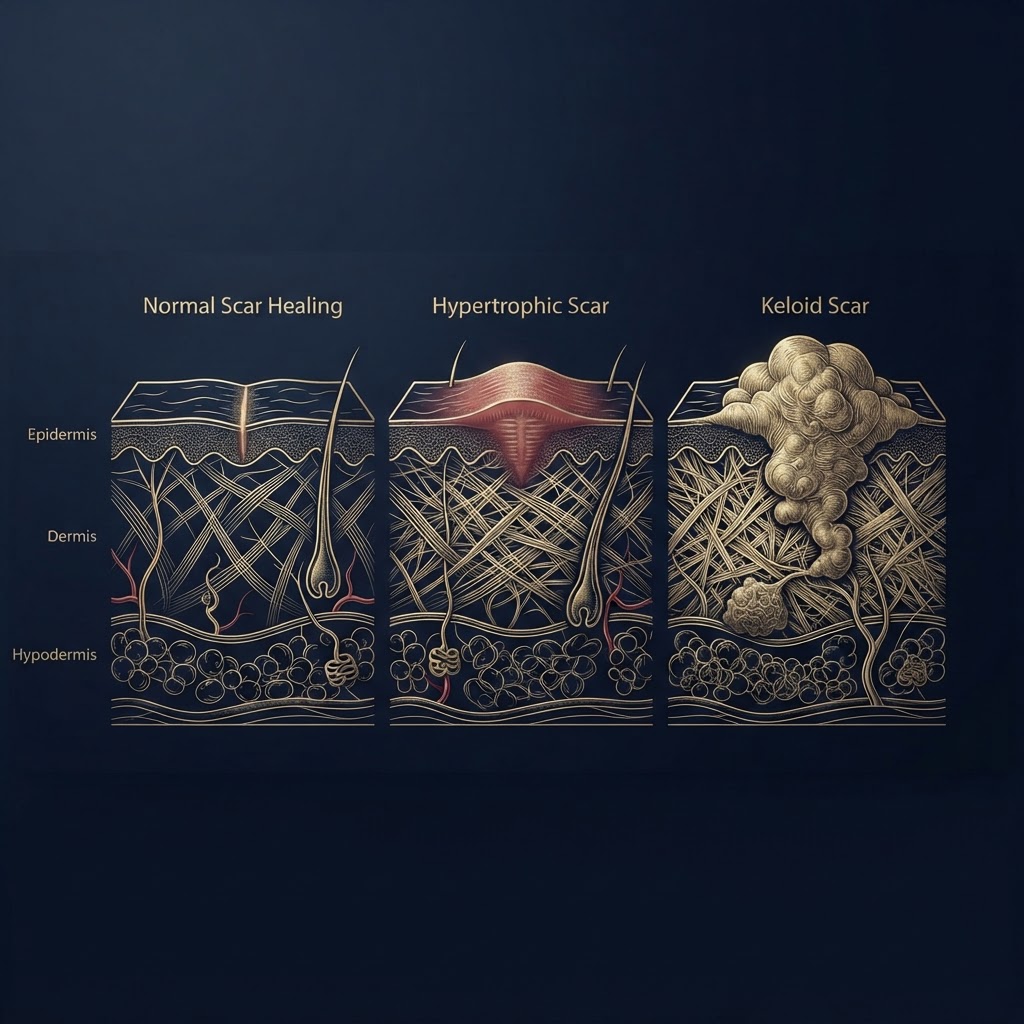
During healing the body can overproduce collagen. If the resulting scar stays within the original wound margins it is hypertrophic; if it grows beyond them it is a keloid.
Beyond appearance, these scars can pull, itch or restrict movement, particularly across joints or after burns. That functional element is often what drives patients to seek treatment, and it is a legitimate medical reason rather than a cosmetic one.
What the evidence says
A systematic review of 25 randomised controlled trials found intralesional injection to be the most effective single modality, with improvement around 64 percent, and reported that combined multi-modal treatment generally outperformed any single treatment in reducing recurrence. (Source: Archives of Dermatological Research (2023), review of 25 randomised trials.)
Why single treatments underperform
There is no one intervention that reliably settles a complex scar. Plans generally combine injection to soften and flatten, surgical techniques to reorient or reposition the scar, and supportive treatments for the surface.
The combination is chosen from the scar type, its location, its age and how it has behaved so far. A protocol applied identically to every scar ignores the variable that matters most.
Where surgery helps and where it backfires
Surgical revision is useful when a scar is wide, tethered, badly oriented or sitting in a conspicuous position. It can be repositioned into a natural crease or its tension redistributed so it heals thinner.
The trap is cutting out a raised scar and expecting a different outcome from the same tissue. Without measures to prevent recurrence, excision of a hypertrophic scar frequently produces another one. Surgery is a component of the plan, not the plan itself.
Scars from previous cosmetic surgery
Some patients arrive with a scar from an operation that was supposed to be discreet. Here scar work overlaps with corrective surgery, because the underlying contour may also need addressing.
Tension is usually the culprit. A closure held under strain while it heals is what widens and thickens a line, which is the same reason low-tension closure matters so much in deep plane technique.
Timing, and why patience pays
Scars change for a long time after they form, often continuing to mature over a year or more. Intervening too early can mean operating on tissue that would have improved on its own.
There are exceptions where early treatment prevents a scar from worsening, particularly in patients with a keloid history. That judgement is part of the assessment rather than a fixed rule.
Setting the expectation honestly
The realistic outcome is a scar that is flatter, paler, softer and far less noticeable, sitting more comfortably with the skin around it. That is a meaningful change, and for tethered or restrictive scars it can be functional as well as visual.
What is not realistic is disappearance. Any plan that promises erasure is describing marketing rather than biology.
How scar type changes the plan
A scar crossing a joint that moves constantly behaves differently from one on a fixed area. A keloid with a history of recurrence needs a more cautious approach than a simple hypertrophic scar.
Skin type, location, age of the scar and how it has behaved so far all influence which combination is chosen. Assessment establishes the type first, and the plan follows from it rather than from a fixed protocol.
Prevention is part of the treatment
A meaningful part of managing complex scars begins before they form. Careful closure technique, minimising tension on the wound and early attentive aftercare all reduce the likelihood of a raised scar developing at all.
In patients with a known tendency to keloid, additional precautions are taken after any surgery to prevent recurrence. This is the same preventive thinking applied throughout revision planning, where the priority is not creating a second problem while solving the first.
Frequently Asked Questions
Can a scar be removed completely?
No scar disappears entirely. The realistic goal is a scar that is flatter, paler, softer and much less noticeable, and for tethered scars, one that no longer restricts movement.
What is the most effective scar treatment?
Evidence from randomised trials points to intralesional injection as the most effective single modality, with improvement around 64 percent. Combined multi-modal treatment generally outperforms any single approach.
Why is surgery alone not enough for a raised scar?
Because excising a hypertrophic scar without measures to prevent recurrence often produces another raised scar from the same tissue behaviour. Surgery works as part of a combined plan.
When should scar treatment start?
Scars mature over a year or more, so intervening too early can mean operating on tissue that would have settled anyway. Patients with a keloid history are an exception where earlier intervention can prevent worsening.
Can scars from previous surgery be improved?
Often yes. These frequently result from closure under tension, and revision can reposition the scar into a natural crease or redistribute tension so it heals thinner, sometimes alongside contour correction.
If a scar bothers you visually or physically, the first step is identifying what type it is and how it has behaved. The Strategic Anatomical Assessment with Dr. Jamil builds a combined plan around that. Arrange a private consultation.