
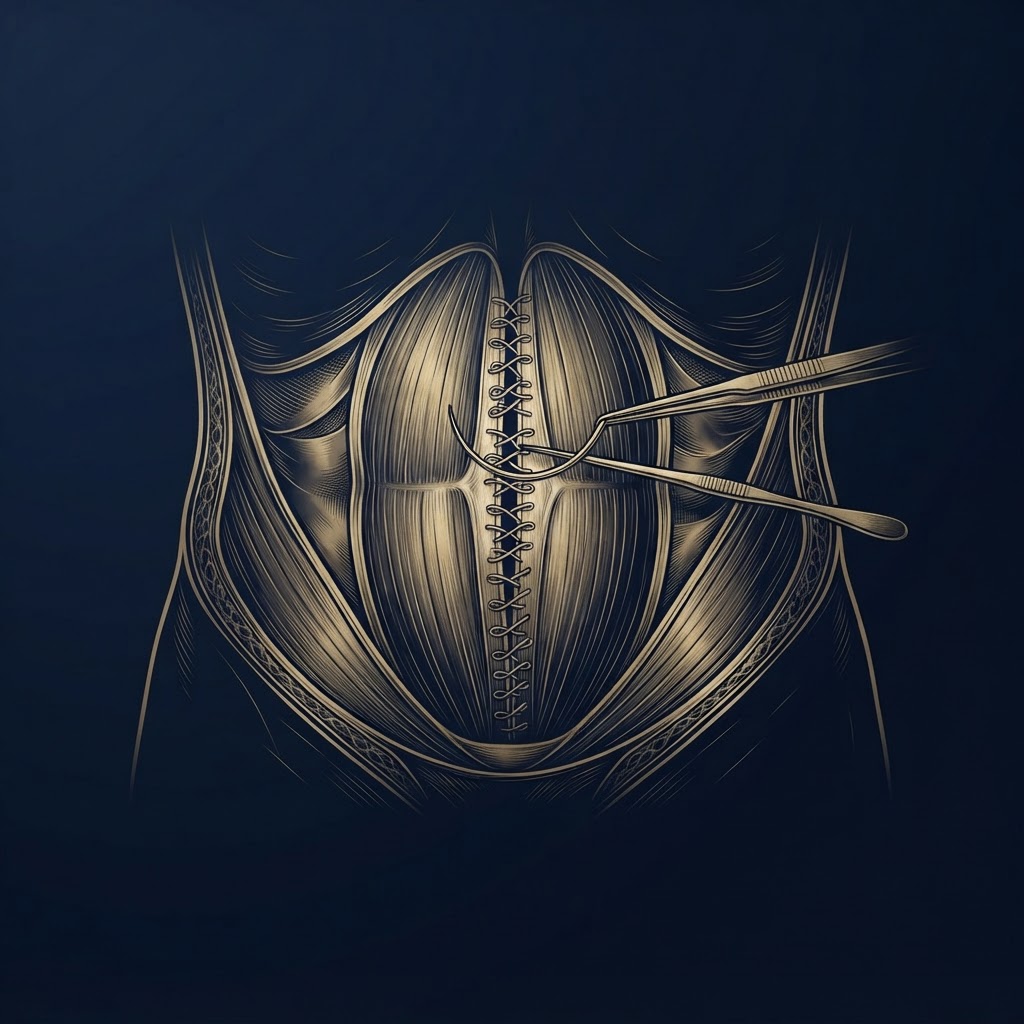
An abdominoplasty is not only a skin operation. Muscles separated by pregnancy are stitched back to the midline, and the early restrictions exist to protect that repair while it holds.
Medically reviewed by Dr. Jamil Al Jamali, German Board (Facharzt) certified Consultant Plastic, Reconstructive & Hand Surgeon, Dubai. Last reviewed: February 2026. About Dr. Jamil.
Key Takeaways
- A tummy tuck includes stitching separated abdominal muscles back to the midline, not just removing skin.
- Early lifting and core restrictions exist to protect that muscle repair while it holds.
- Most people return to desk work in two to three weeks; full activity waits around six.
Recovery advice after a tummy tuck often sounds arbitrary. No lifting, no core exercise, walk slightly bent for the first days. Without the reason, these instructions feel like excessive caution and get quietly ignored.
The reason is structural. In most abdominoplasties the abdominal muscles, separated during pregnancy, are stitched back together in the midline. That repair is a fresh internal seam, and the early restrictions exist to protect it.
What the evidence says
The American Society of Plastic Surgeons describes rectus diastasis repair as an integral part of a tummy tuck, performed by suturing the separated muscles back to the midline, which is precisely why the early recovery restrictions on lifting and core strain exist and are not optional. (Source: the American Society of Plastic Surgeons.)
Days one to seven: protecting the seam
The first week is dominated by tightness across the abdomen, which is the muscle repair under tension rather than a complication. Walking slightly bent at the waist is normal and expected.
Short, frequent walks matter from the first day for circulation, while anything that strains the abdomen does not. Drains, when used, are usually removed within this window.
Weeks two to three: back to desk life
Swelling and bruising begin to settle and most patients feel able to return to desk-based work around this point. Standing upright becomes comfortable again as the repair settles.
The temptation to test the abdomen rises here precisely because you feel better. This is the phase where the muscle repair is strong enough to feel fine and not yet strong enough to load.
Weeks four to six: the threshold
Contour starts to emerge as swelling reduces. Light lower-body activity may be cleared, but core work, heavy lifting and high-impact exercise generally wait until around six weeks.
That six-week mark is not a superstition. It reflects how long the repaired muscle and fascia need before they can take load without risk of the repair stretching.
Months two to six: refinement
Residual swelling, particularly in the lower abdomen, continues to settle over months. The scar passes through a firm, pink phase before softening and fading, which is the slowest part of the process.
The navel is frequently the last detail to look natural, and it is the most technically demanding part of the operation, as covered in the article on why the belly button is the hardest part.
When it is part of a larger plan
Where abdominoplasty is combined with other procedures, as in a Mommy Makeover, recovery is planned around the most restrictive component rather than the sum of the parts.
Combining sensibly can mean one recovery instead of two, but it also means the abdominal restrictions govern the timeline. That trade-off is discussed in the overview of what a Mommy Makeover involves.
What genuinely slows healing
Smoking materially increases the risk of wound healing problems in abdominoplasty, more so than in many other procedures. Early return to strenuous exercise, uncontrolled weight fluctuation and skipping compression garments all work against the result.
The structured follow-up Dr. Jamil uses treats this period as part of the surgery.
Compression, drains and what they are for
A compression garment reduces swelling, supports the repair and helps the skin settle onto the new contour. It is uncomfortable and it is not optional in the early phase.
Whether drains are used depends on technique. Drainless approaches rely on internal sutures that close the space where fluid would otherwise collect, which reduces the nuisance of drains but does not shorten the muscle repair timeline.
Realistic expectations for the scar
The abdominoplasty scar is long and permanent, positioned low so that underwear conceals it. It passes through a firm, pink phase for several months before softening and fading.
Judging it at six weeks means judging an immature scar. Patients who protect it from sun and follow aftercare through the first year generally end up with a finer line than those who assess it early and lose interest.
Frequently Asked Questions
How long is recovery after a tummy tuck?
Most patients return to desk-based work in two to three weeks. Core exercise, heavy lifting and high-impact activity generally wait until around six weeks, and swelling continues settling for months.
Why can I not lift anything after a tummy tuck?
Because the separated abdominal muscles are stitched back to the midline during surgery. Loading that repair before the tissue has healed risks stretching it, which would undo the structural part of the operation.
When can I exercise again after abdominoplasty?
Light lower-body activity may be cleared around four weeks, while core work and heavy lifting typically wait until about six. The timeline reflects healing of the muscle repair rather than how you feel.
How long does swelling last after a tummy tuck?
Most visible swelling settles within the first few weeks, but residual swelling in the lower abdomen can persist for several months. Final contour and scar softening take longer still.
Does a tummy tuck recovery change if combined with other procedures?
Recovery is planned around the most restrictive component, which is usually the abdomen. Combining procedures can mean one recovery instead of two, but the abdominal restrictions set the timeline.
If you are planning abdominal surgery and need to know what the recovery will actually ask of you, the Strategic Anatomical Assessment with Dr. Jamil covers both the operation and the weeks that follow. Arrange a private consultation.